



If you’re weighing up dental implants and wondering whether the cost makes sense over a lifetime, the longevity question is probably the first thing you want answered. And it’s a fair one. An implant is a significant investment, and you want to know what you’re actually getting for your money.
The honest answer is that how long your implant lasts depends far more on you than it does on the implant itself. The hardware is built to last. What determines whether it actually does comes down to how well you clean it, your general health, your lifestyle, and whether you keep up with professional care. Understanding that shift in responsibility is the most useful thing this article can give you, so it’s worth starting there before we get into the numbers.
Before we go further, it’s also worth knowing that implant costs at Smile9 start from £2,500 covering everything, and that routine hygiene care – which plays a direct role in how long your implant lasts – is available through our practice membership plan from £22.50 a month.
What the 20-year evidence actually says
Most of what you’ll read online about implant longevity is vague. “They can last a lifetime” is technically true and practically useless. So, here’s something more concrete.
A 2026 systematic review and meta-analysis published in the International Journal of Oral and Maxillofacial Surgery looked at ten prospective studies tracking 1,028 implants over a minimum of twenty years. Of those, 115 failed. That gives a twenty-year survival rate of 93%, with a confidence interval of 91.6 to 94.1%.
That’s a strong number so let’s be clear about what it means. It refers to the implant post in the jawbone, not the crown on top. It also comes with caveats the authors themselves flag: the certainty of evidence is rated as moderate, and there’s substantial variation between the studies included. A separate 2024 meta-analysis reached broadly similar figures across prospective studies but lower figures when different methodology was applied. The science is good, not perfect, and any dentist presenting these numbers as a guarantee is overstating them.
What they do tell you is that for the right patient who looks after their implant properly, the odds of it still being in place two decades later are very high.
An implant is two things and they fail differently
This is one of the most practically useful things to understand, and it tends to get glossed over.
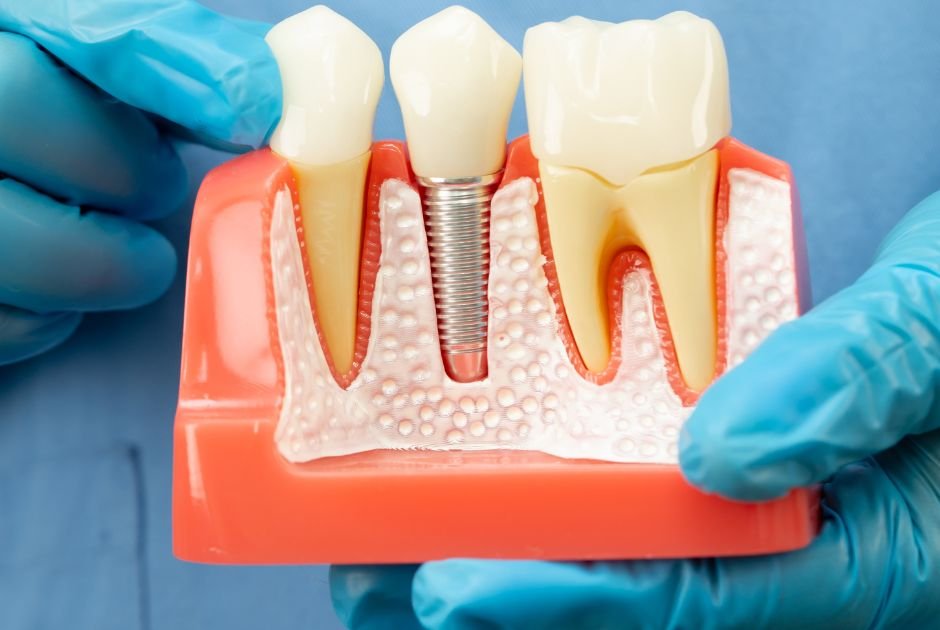
A dental implant has two components: the titanium post in the jawbone, and the crown fitted on top. The survival statistics above refer to the post. The crown is a separate matter entirely.
Crowns can chip or fracture over time, just like natural teeth. If that happens, it can simply be replaced on top of the existing post. That’s a routine appointment, not a procedure. The post failing is a different situation altogether and means the whole implant needs to be removed and replaced.
So, if you ever hear someone say their implant broke, the first question is which part. In most cases, it’s the crown, and that’s the good version of events. The post itself is durable and, in the studies above, survives intact in the vast majority of patients over very long periods.
Peri-implantitis: the thing that actually causes implants to fail
Most people have never heard this word before they start researching implants. It’s worth understanding because it’s the single biggest threat to long-term implant success.
Around a natural tooth, bacterial build-up causes gum disease. Around an implant, the same process is called peri-implantitis — inflammation of the gum tissue surrounding the implant. Left unchecked, that inflammation causes the bone to shrink away from the implant. Once enough bone is lost, the implant loosens. That’s how implants fail.
The drivers are straightforward: not cleaning well, not flossing, smoking and uncontrolled diabetes, which affects gum health directly. That last point is important to state precisely. Diabetes doesn’t automatically disqualify someone from having implants, but uncontrolled diabetes does create a meaningful risk to gum health that needs to be factored in at the consultation stage.
The practical takeaway is that an implant actually needs more cleaning attention than a natural tooth, not less. It can’t decay — the post is titanium and the crown is ceramic — but the gum around it absolutely can become inflamed, and that’s what starts the chain of events that leads to failure.
The load your implant carries is important
Here’s something that rarely comes up in general conversations about implants, but it matters a lot over the long term.
Your implant doesn’t exist in isolation. It shares bite load with every other tooth in your mouth. If teeth elsewhere are lost and not replaced, that load concentrates increasingly on the teeth and implants that remain. Over years, that concentrated pressure can cause an implant post to fracture in the jawbone – a far more serious event than a crown chipping.
This is why dentists will sometimes decline to place an implant even when a patient is otherwise suitable. A patient who has lost most of their back teeth and is already biting heavily on their front teeth is not a good candidate for a single front implant, because the load it would need to carry makes long-term success unlikely. That kind of honest assessment isn’t a refusal to help — it’s a dentist putting clinical outcome ahead of a booking.
The wider point is that replacing missing teeth matters not just for the gaps themselves, but for the health of everything around them, including any implants you already have.
Professional hygiene appointments aren’t optional
Daily cleaning at home is essential, but it isn’t enough on its own. Professional hygiene appointments every three to six months are specifically recommended for implant patients, both to remove build-up that home cleaning misses and to catch early signs of gum inflammation before they develop into something more serious.
Smile9’s Airflow scale and polish is particularly well suited to cleaning around implants, and regular hygiene visits are included as part of the practice membership plan, which spreads the cost across the year rather than landing it all at once. Given how directly professional hygiene care connects to implant longevity, that’s one of the more practical reasons to consider membership if you have implants or are planning to get them.
Is it worth it over the long term?
At £2,500 for a single implant including all scans, the post and the final crown, the cost is real. But spread across twenty years of daily use — three meals a day, every day — the arithmetic starts to look different. The post is the long-lived component. The crown is more like a consumable that may need attention over that period, but replacing a crown on an existing post is a routine procedure, not a significant cost.
The 93% twenty-year survival figure is the best current evidence we have, and it comes from patients across a range of health profiles and care habits. For someone in good general health who cleans well, attends regular hygiene appointments and doesn’t smoke, the real-world figure is likely to be higher than that average.
Implants don’t suit every patient and every case. But for the right candidate, they are the closest thing dentistry has to a permanent tooth replacement solution — and the evidence, honestly presented, supports that.
If you’d like to find out whether implants are right for you, get in touch with the Smile9 team to book a free consultation.